Preah Ko Temple is one of the oldest and most historically significant temples in the Angkor region. Located in the Roluos Group, southeast of Siem Reap, this ancient Hindu temple is famous for its six brick towers, detailed sandstone carvings and connection to the early Khmer kings.
Built under King Indravarman I and consecrated in 879 AD, Preah Ko predates Bakong Temple and offers an opportunity to explore the religious traditions and architectural achievements that shaped the early Khmer Empire.
Its name means “Sacred Bull”, referring to Nandi, the sacred bull associated with the Hindu god Shiva. The temple is a particularly rewarding stop for visitors interested in Khmer history, Hindu mythology and early Angkorian architecture.
Preah Ko Temple, Siem Reap: History, Architecture & Visitor Guide
Quick Facts About Preah Ko Temple
| Information | Details |
|---|---|
| Temple Name | Preah Ko Temple |
| Khmer Name | ប្រាសាទព្រះគោ |
| Meaning | Sacred Bull |
| Historical Period | 9th century |
| Consecrated | 25 January 880 AD |
| King | Indravarman I |
| Original Religion | Hinduism |
| Main Deity | Shiva |
| Architectural Style | Preah Ko |
| Location | Roluos, Prasat Bakong District, Siem Reap Province |
| Distance from Siem Reap | Approximately 13–15 km east |
| Opening Hours | 7:30 AM – 5:30 PM (APSARA published information) |
| Recommended Visit | 30–45 minutes |
| Entrance Ticket | Angkor Pass; confirm current coverage |
| Best Time to Visit | November–February |
1. History of Preah Ko Temple
Preah Ko Temple is one of the earliest major monuments of the Khmer Empire. It was consecrated on 25 January 880 AD by King Indravarman I, who ruled from the ancient capital of Hariharalaya, now known as the Roluos area.
The name Preah Ko translates as "Sacred Bull" and refers to Nandi, the sacred bull associated with Shiva in Hinduism.
The temple was originally called Paramesvara, a name associated with Shiva and also the posthumous name of King Jayavarman II, the founder of the Angkorian Empire.

Unlike temples built primarily to celebrate a king's own reign, Preah Ko was designed as an ancestral temple. Its six main towers were dedicated to the king's ancestors.
The three eastern towers were dedicated to male ancestors, while the three western towers honoured female ancestors. The central eastern sanctuary was dedicated to Jayavarman II, while the other towers commemorated members of Indravarman I's family.
This tradition of building temples to honour royal ancestors became an important feature of Khmer royal architecture.
Preah Ko was built before Bakong Temple, the famous pyramid-shaped state temple of Indravarman I. Together, these monuments help explain the development of the early Khmer capital at Hariharalaya.
2. Why Is Preah Ko Temple Special?
Six brick towers on a single platform
The most recognisable feature of Preah Ko is its arrangement of six brick towers standing on a shared raised platform.
They are organised into two rows of three, with the eastern row facing the main entrance.
The arrangement is not random. Each tower has a specific religious and ancestral purpose.
Fine stucco decorations
Preah Ko is particularly famous for its decorative stucco work.
The original brick towers were covered with finely carved plaster decorations, including floral patterns, figures and other ornamental details.
Although much of the original stucco has disappeared over time, surviving sections give visitors an idea of how richly decorated the temple once appeared.
Nandi bull statues
The sacred bull Nandi is closely associated with Shiva and gives the temple its name.
Visitors can see stone bull sculptures positioned in front of the eastern sanctuaries. These figures symbolically face the temple towers and represent Nandi's role as Shiva's vehicle and devoted companion.
Early Khmer architectural style
Preah Ko represents an important stage in the development of Khmer temple architecture.
Its brick towers, sandstone doorframes, carved lintels and stucco decorations became influential features in later Khmer religious buildings.
3. What to See at Preah Ko Temple
3.1 The six brick towers
The six main towers are the central attraction.
Take time to examine their different decorative details. Although they share a similar overall design, the towers were dedicated to different ancestors and have individual architectural features.
The eastern row contains the three principal sanctuaries, while the western row completes the ancestral arrangement.
3.2 Nandi bull sculptures
Look towards the eastern side of the temple platform to find the sacred bull sculptures.
Nandi is traditionally associated with Shiva and is often represented sitting in front of a Shiva sanctuary.
These sculptures are an important part of the temple's religious symbolism.
3.3 Sandstone doorways and lintels
The doorframes and lintels display detailed Khmer craftsmanship.
Look for decorative motifs inspired by Hindu mythology, floral designs and traditional architectural patterns.
These details are particularly interesting for visitors who enjoy photography and studying ancient Khmer art.
3.4 Stucco remains
Some sections of the original stucco decoration remain visible on the brick towers.
These fragments are important because they reveal that early Khmer temples were not simply exposed brick structures. They were once covered with elaborate decorative surfaces.
3.5 The temple enclosure
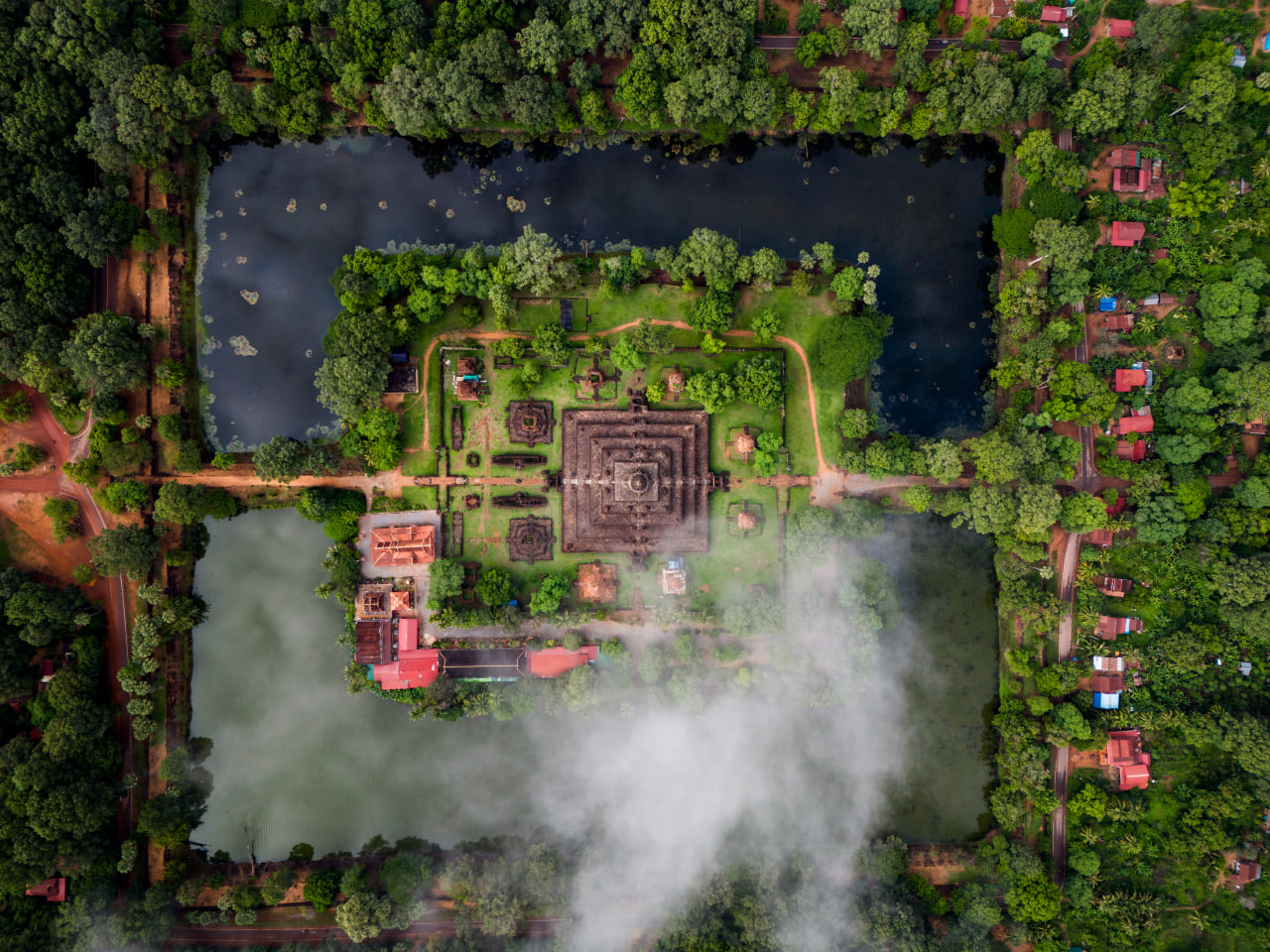
The wider archaeological enclosure measures approximately 500 metres by 400 metres.
The surviving six towers are the most prominent features, but the surrounding area was historically part of a larger religious and settlement landscape.
Walk around the temple to appreciate its layout and relationship with the surrounding Roluos area.
4. Location: How to Get to Preah Ko Temple
Preah Ko is located in the Roluos archaeological area, approximately 13–15 kilometres east of Siem Reap city.
It is normally included in a visit to the three main Roluos Group temples:
- Preah Ko
- Bakong
- Lolei
| Transport | Estimated Travel Time | Notes |
|---|---|---|
| Tuk-tuk | 30–40 minutes | Convenient for a temple visit |
| Private car | 25–35 minutes | Comfortable for families and groups |
| Motorbike | 25–35 minutes | Suitable for experienced riders |
| Bicycle | 45–75 minutes | Possible, but consider heat and traffic |
| Guided tour | Depends on itinerary | Often includes all three Roluos temples |
Travel times are approximate and depend on traffic and your starting point.
5. Road Conditions and Accessibility
The journey from Siem Reap to Preah Ko is generally straightforward. Visitors travel east towards the Roluos area, mainly using the road network around National Road 6 before taking the local access road to the temple.
| Travel Detail | Practical Information |
|---|---|
| Main route | Siem Reap – Roluos – Preah Ko |
| Road surface | Main roads are generally paved |
| Suitable vehicles | Car, SUV, tuk-tuk and motorbike |
| Rainy-season risks | Rain may create slippery surfaces, standing water and muddy sections on smaller roads |
| Final approach | Local road access leads to the temple grounds |
| Walking required | Short walk around the temple and platform |
| Accessibility | Uneven ground and steps; not fully wheelchair accessible |
Preah Ko is relatively compact compared with larger Angkor temples. Most visitors can explore the main structures without extensive walking.
However, the ground around the ancient towers is uneven, and visitors should take care when walking near damaged stonework.
During the rainy season, allow extra travel time and check local road conditions before departure. Standard cars and tuk-tuks are generally suitable for the normal approach, but conditions on smaller roads can change after heavy rainfall.
6. Opening Hours
According to APSARA National Authority's published visitor information, Preah Ko Temple is open daily during the following hours:
| Day | Opening Time | Closing Time |
|---|---|---|
| Monday–Sunday | 7:30 AM | 5:30 PM |
Hours may change due to conservation work or special circumstances. Check current information before visiting.
7. Entrance Fee: Do You Need an Angkor Pass?
Preah Ko is part of the Roluos Group and is generally visited using an Angkor Archaeological Park pass.
The published standard Angkor Pass prices are:
| Ticket Type | Standard Price |
|---|---|
| 1-day pass | US$37 |
| 3-day pass | US$62 |
| 7-day pass | US$72 |
Confirm current ticket prices and coverage with Angkor Enterprise before travelling.
The official ticket website is:
It is advisable to purchase your ticket before travelling to the Roluos temples rather than assuming tickets can be purchased at the site.
8. Best Time to Visit Preah Ko Temple
The best months to visit are generally November to February, when temperatures are more comfortable for exploring the temple grounds.
| Season | Months | Visitor Experience |
|---|---|---|
| Cool season | November–February | Comfortable conditions for walking and photography |
| Hot season | March–May | Hot afternoons; morning visits recommended |
| Rainy season | June–October | Green surroundings, with possible rain and slippery surfaces |
Recommended time of day: Visit in the morning, when the temperature is cooler and the eastern-facing towers receive attractive natural light.
9. How Long Should You Spend at Preah Ko?
Preah Ko is a relatively compact temple. APSARA recommends approximately 45 minutes for a visit.
| Activity | Estimated Time |
|---|---|
| Explore the six brick towers | 15–20 minutes |
| View Nandi bull sculptures | 5–10 minutes |
| Examine lintels and stucco details | 10 minutes |
| Walk around the temple enclosure | 10–15 minutes |
| Photography | 5–10 minutes |
Visitors with a strong interest in Khmer architecture may want to spend longer examining the decorative details.
10. Nearby Attractions: Explore the Roluos Group
Preah Ko is best visited together with the other major monuments of the Roluos Group.
| Attraction | Main Highlight | Suggested Visit |
|---|---|---|
| Bakong Temple | Five-tiered pyramid and temple-mountain architecture | 45–90 minutes |
| Lolei Temple | Brick towers and historical inscriptions | 20–30 minutes |
| Prei Monti | Smaller archaeological remains associated with early Hariharalaya | Optional stop |
| Wat Roluos | Local Buddhist pagoda and community atmosphere | 15–30 minutes |
Bakong Temple
Bakong is the most monumental temple in the Roluos Group. Built under King Indravarman I, it represents an important development in Khmer temple-mountain architecture.
Lolei Temple
Lolei was built under King Yasovarman I and is known for its brick towers, inscriptions and historical connection to the ancient reservoir known as Indratataka.
11. Suggested Half-Day Roluos Group Itinerary
A half-day visit allows enough time to explore the three major temples without rushing.
| Time | Activity |
|---|---|
| 8:00 AM | Depart from Siem Reap |
| 8:30 AM | Arrive at Preah Ko Temple |
| 8:30–9:15 AM | Explore Preah Ko |
| 9:30 AM | Visit Bakong Temple |
| 9:30–10:45 AM | Explore Bakong |
| 11:00 AM | Visit Lolei Temple |
| 11:00–11:30 AM | Explore Lolei |
| 12:00 PM | Return to Siem Reap |
The order can be adjusted according to your driver, tour guide and preferred photography conditions.
12. Practical Tips for Visiting Preah Ko Temple
- Visit with the Roluos Group. Combining Preah Ko with Bakong and Lolei makes better use of your travel time.
- Bring drinking water. Even a short temple visit can become hot during the afternoon.
- Wear comfortable shoes. The grounds contain uneven surfaces and old stone structures.
- Bring a camera. The brick towers and decorative details are excellent photography subjects.
- Visit in the morning. Cooler temperatures make exploring more comfortable.
- Respect the historical structures. Do not climb on fragile brickwork or touch damaged carvings.
- Hire a knowledgeable guide. The temple's ancestral symbolism is easier to understand with historical context.
- Check your Angkor Pass. Confirm ticket validity and coverage before entering the Roluos Group.
13. Frequently Asked Questions
Where is Preah Ko Temple located?
Preah Ko is located in the Roluos area of Prasat Bakong District, approximately 13–15 kilometres east of Siem Reap city.
Who built Preah Ko Temple?
King Indravarman I commissioned Preah Ko, which was consecrated on 25 January 880 AD.
What does Preah Ko mean?
Preah Ko means "Sacred Bull" in Khmer. The name refers to Nandi, the sacred bull associated with the Hindu god Shiva.
How many towers does Preah Ko have?
The temple has six main brick towers arranged in two rows of three on a shared platform.
What religion was Preah Ko Temple dedicated to?
Preah Ko was originally a Hindu temple dedicated to Shiva.
Why was Preah Ko built?
The temple was built to honour the king's ancestors and became an important example of the royal ancestral temple tradition in Khmer history.
Is Preah Ko part of the Roluos Group?
Yes. Preah Ko is one of the three principal monuments of the Roluos Group, together with Bakong and Lolei.
How long does it take to visit Preah Ko?
Approximately 30–45 minutes is sufficient for most visitors.
Do I need an Angkor Pass to visit Preah Ko?
Preah Ko is generally visited under the Angkor ticketing system. Confirm current access and ticket coverage with Angkor Enterprise before travelling.
TravelKH Tip
Preah Ko may not be as visually imposing as Angkor Wat or Bakong, but it is one of the most important places to understand the origins of Khmer temple architecture.
Pay special attention to the six brick towers, the Nandi bull sculptures and the surviving stucco decorations. These details reveal how the early Khmer kings used architecture to express religious beliefs, royal authority and respect for their ancestors.
For a more complete experience, visit Preah Ko together with Bakong and Lolei. The three temples tell an important story about the ancient capital of Hariharalaya and the early development of the Khmer Empire.
Official and Useful References
- APSARA National Authority – Preah Ko Temple: https://apsaraauthority.gov.kh/2021/08/12/preah-ko-temple/
- UNESCO World Heritage Centre – Angkor: https://whc.unesco.org/en/list/668/
- Angkor Enterprise – Official Angkor Pass Information: https://www.angkorenterprise.gov.kh/
- Tourism Cambodia: https://www.tourismcambodia.com/
Editorial note: Opening hours, ticket coverage and visitor arrangements may change. Verify current information with APSARA National Authority and Angkor Enterprise before travelling.