
Moving to Cambodia can be an exciting experience, whether you are working, running a business, studying, retiring or joining your family.
However, living in another country means keeping important personal, immigration and legal documents organized. Foreign residents may need to show proof of identity, valid immigration status, employment authorization, residential address or other supporting documents when dealing with government offices, banks, employers and service providers.
Whether you are a new arrival or a long-term expatriate, keeping the right documents can help you avoid unnecessary delays and make everyday life in Cambodia easier.
This guide provides a practical document checklist for foreigners living in Cambodia.
1. Passport and identity documents
Your passport is one of the most important documents to maintain while living in Cambodia.
Keep the following documents accessible:
| Document | Why you need it |
|---|---|
| Valid passport | Main international identity and travel document |
| Passport information page copy | Useful for administrative applications |
| Cambodian visa or extension of stay | Evidence of your immigration permission |
| Entry stamp or entry record | Helps verify your latest entry into Cambodia |
| Passport-size photographs | Frequently requested for applications |
| National identity card from your home country | Additional identification, where applicable |
| Birth certificate | May be needed for family, school or other applications |
Practical advice: Keep your original passport in a secure location when you do not need it for an official appointment or travel. Carry a photocopy or secure digital copy for routine reference, but understand that a copy does not replace the original when authorities or institutions require it.
Check your passport's expiry date well in advance. If you renew your passport while in Cambodia, ask Cambodian immigration how to transfer or update your existing visa and stay records.
2. Visa and immigration documents
Foreigners must maintain valid immigration permission while staying in Cambodia.
Depending on your nationality and purpose of stay, your immigration documents may include a Tourist Visa, Ordinary E-Class Visa, Courtesy Visa, Diplomatic Visa or an applicable extension of stay.
Keep copies of:
- Original passport and relevant visa pages.
- Latest Cambodian entry stamp.
- Extension of stay sticker or electronic record, where applicable.
- Visa application and approval documents.
- Immigration receipts and payment records.
- Previous visa and extension records.
- Relevant immigration correspondence.
- Departure and re-entry records, if applicable.
Why are these documents important?
You may need them when:
- Renewing your visa or extension of stay.
- Applying for a new passport.
- Changing your immigration category, where permitted.
- Leaving and re-entering Cambodia.
- Applying for certain employment or banking services.
- Confirming your legal stay with an authority.
Important: A visa's validity and the permitted length of stay are not necessarily the same thing. Always check the actual entry and stay conditions shown on your immigration documents.
For official entry information, visit the Cambodia e-Visa website.
3. Foreigners Present in Cambodia System (FPCS) registration
FPCS is an important registration system for foreign nationals staying in Cambodia.
The Foreigners Present in Cambodia System is used to record foreign residents' accommodation information.
Depending on where you stay, registration is generally handled by:
- Hotel or guesthouse management.
- Your landlord or accommodation owner.
- The owner of the property where you are staying.
- You, if you own or occupy accommodation and are responsible for completing your own registration.
Foreign residents should confirm that their accommodation information has been correctly registered.
Keep:
- Confirmation or evidence of FPCS registration, if available.
- Your registered Cambodian residential address.
- Landlord or property owner's contact details.
- Previous accommodation registration details if you move.
Why it matters: Foreign residents may encounter problems with immigration procedures if their accommodation registration is missing or incorrect. Check your registration rather than assuming that your landlord has completed it.
4. Work permit and employment documents
Foreigners working in Cambodia should pay particular attention to employment authorization.
Under Article 261 of Cambodia's Labour Law, foreign nationals generally require a work permit and employment card issued by the Ministry of Labour and Vocational Training (MLVT), subject to applicable legal arrangements and exemptions.
Keep the following documents:
| Document | Purpose |
|---|---|
| Foreign work permit | Evidence of employment authorization |
| Employment card or employment book | Relevant labour identification record |
| Employment contract | Proof of employment terms |
| Employer's company registration details | Supporting information about the employer |
| Work permit application or renewal receipts | Application history |
| Health certificate | Where required for employment procedures |
| Salary records or payslips | Employment and income evidence |
| Employment termination or resignation letter | Useful when changing jobs |
Annual work permit renewal
Foreign employees should check the current annual work permit and employment book renewal requirements with their employer and MLVT.
Employers generally assist with applications through the Foreign Workers Centralized Management System (FWCMS).
Official platform: https://fwcms.mlvt.gov.kh/
Important: A valid visa or extension of stay does not automatically replace a required work permit. Foreign employees should keep their immigration and labour documents up to date separately.
5. Residential and rental documents
Whether you rent an apartment, condominium, house or room, keep a copy of your accommodation agreement.
Recommended documents include:
- Rental agreement or lease contract.
- Landlord's name and contact details.
- Property address.
- Rental deposit receipt.
- Monthly rental payment records.
- Utility payment receipts.
- Property handover or inventory checklist.
- Written confirmation of any lease renewal.
- FPCS registration details.
Why keep your rental agreement?
A rental agreement can help when:
- Confirming your residential address.
- Applying for certain administrative services.
- Resolving disputes about deposits or rental payments.
- Confirming the agreed rental period.
- Providing supporting documents for other applications.
Before signing a lease, check the rental amount, deposit conditions, termination notice, maintenance responsibilities and utility arrangements.
6. Driving licence and vehicle documents
Foreign residents who drive in Cambodia should maintain valid driving documents.
Depending on the type of vehicle and their circumstances, they may need:
- Valid Cambodian driving licence, where required.
- Recognized international driving permit, where applicable.
- Original driving licence from their home country.
- Vehicle registration documents if they own a vehicle.
- Valid vehicle insurance.
- Road tax or applicable vehicle tax documents.
- Vehicle inspection documents, where required.
- Purchase or ownership documents.
Can foreigners drive in Cambodia using a foreign licence?
Driving eligibility depends on the licence, vehicle category, nationality and applicable Cambodian recognition requirements.
Do not assume that every foreign driving licence or international driving permit is automatically accepted for every purpose or length of stay.
Check the current requirements with the Cambodian Ministry of Public Works and Transport or the relevant licensing authority before driving.
For car owners, keep vehicle ownership and insurance documents organized in case of an accident, inspection or insurance claim.
7. Health and medical documents
Healthcare documents are especially important for foreigners who live in Cambodia long-term.
Keep a personal medical file containing:
- Health insurance policy.
- Insurance membership card.
- Emergency contact information.
- Medical history and important diagnoses.
- Prescription records.
- Vaccination records.
- Allergy information.
- Previous medical reports.
- Medical examination certificates, where applicable.
- Hospital and clinic contact details.
If you take regular medication, keep a copy of the prescription and the generic name of the medicine.
Health insurance
Foreigners should consider suitable medical insurance that covers their needs in Cambodia.
Check:
- Hospital and clinic coverage.
- Emergency treatment.
- Inpatient and outpatient benefits.
- Medical evacuation.
- Coverage outside Cambodia.
- Pre-existing condition exclusions.
- Claims procedures.
Do not rely only on a photograph of your insurance card. Keep the insurer's emergency contact number and policy details accessible.
8. Banking and financial documents
Foreign residents may need supporting documents when opening bank accounts, updating personal information or completing financial transactions.
Keep copies of:
- Passport and visa.
- Proof of residential address.
- Employment contract or business documents.
- Salary slips or income statements.
- Bank account opening documents.
- Bank account details and contact information.
- Tax identification information, if applicable.
- Loan or financing agreements.
- International transfer receipts.
- Important financial correspondence.
Banks have their own customer verification requirements. The documents accepted by one bank may differ from those accepted by another.
Security tip: Never store your banking password, PIN or one-time verification codes in the same folder as your identity documents.
9. Tax and business documents
Foreigners who work, operate a business or receive income in Cambodia should maintain relevant financial and tax records.
Depending on your situation, keep:
- Employment income records.
- Salary statements.
- Tax payment receipts.
- Tax registration information, if applicable.
- Tax residency or tax advice records.
- Business registration documents.
- Patent tax certificates, where applicable to your business.
- Tax invoices and receipts.
- Accounting records.
- Business contracts.
- Relevant correspondence with the General Department of Taxation.
Do foreigners need to pay tax in Cambodia?
Tax obligations depend on your residence status, income sources, employment arrangements and applicable Cambodian tax rules.
Do not assume that earning income from overseas automatically means you have no Cambodian tax obligations.
For business and personal tax matters, consult the General Department of Taxation or a qualified Cambodian tax adviser.
10. Family and children's documents
Foreign families living in Cambodia should keep a separate folder for each family member.
Recommended documents include:
- Passports.
- Visas and extensions of stay.
- Birth certificates.
- Marriage certificate.
- School enrollment letters.
- Previous school records.
- Vaccination records.
- Medical insurance documents.
- Custody or guardianship documents, if applicable.
- Relevant parental consent documents for travel, where needed.
These records may be needed for school enrollment, visa applications, family relocation, medical care and travel.
If documents were issued overseas, check whether Cambodian authorities or schools require certified translations, notarization, legalization or other authentication.
11. Emergency and important contact information
In addition to legal and administrative documents, every foreign resident should keep an emergency contact sheet.
Include:
| Information | Details to keep |
|---|---|
| Home country's embassy | Address, telephone and emergency contact |
| Landlord | Name and telephone |
| Employer | HR contact and office address |
| Insurance company | Policy number and emergency hotline |
| Hospital or clinic | Preferred medical facility |
| Bank | Customer service contact |
| Family contact | Emergency contact outside Cambodia |
| Immigration | Relevant official contact information |
Save important contact numbers on your phone and keep a printed copy somewhere accessible.
12. How to organize your documents
Keeping documents is not enough. You should also be able to find them quickly.
A simple folder system can help.
Folder 1 – Identity and Immigration
- Passport.
- Visa.
- Entry stamp.
- Extension of stay.
- FPCS registration.
Folder 2 – Employment
- Work permit.
- Employment card.
- Employment contract.
- Salary records.
- Employer documents.
Folder 3 – Accommodation
- Rental agreement.
- Deposit receipts.
- Utility bills.
- Landlord information.
Folder 4 – Health
- Insurance.
- Medical records.
- Prescriptions.
- Vaccination records.
Folder 5 – Finance and Tax
- Bank documents.
- Tax records.
- Income statements.
- Business documents.
Folder 6 – Family
- Marriage certificate.
- Children's birth certificates.
- School records.
- Family immigration documents.
Digital document storage
It is useful to keep secure digital copies of important documents.
Recommended practices:
- Scan documents in clear PDF format.
- Use descriptive filenames.
- Keep a backup in secure cloud storage.
- Protect devices with strong passwords.
- Enable two-factor authentication.
- Restrict access to sensitive folders.
- Keep copies of essential documents offline in case you cannot access the internet.
Never share passport scans or personal documents with unverified individuals.
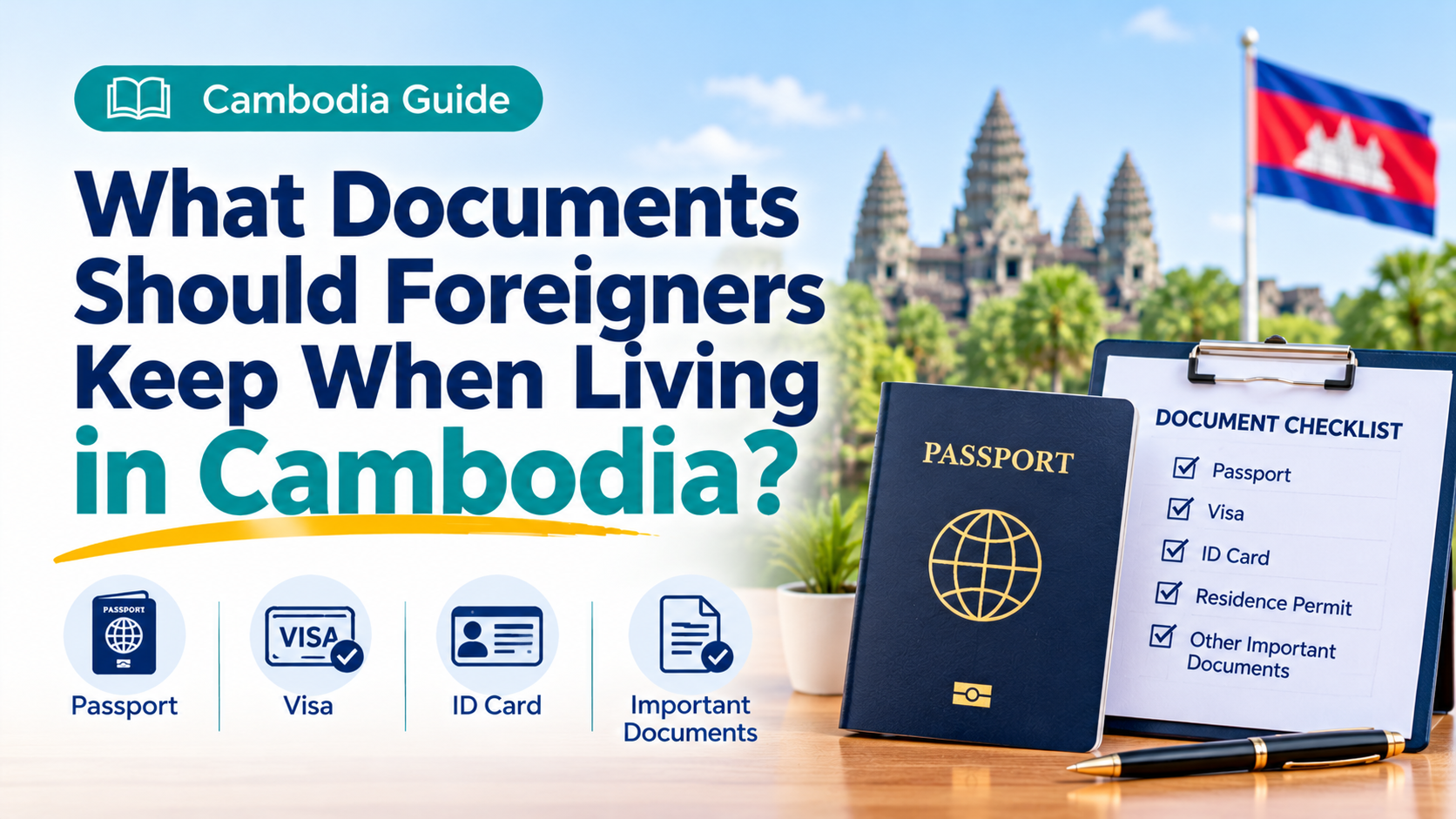
13. Foreigners' document checklist for living in Cambodia
Use this checklist to review your essential records.
Identity and immigration
- Valid passport.
- Valid Cambodian visa or extension of stay.
- Latest entry stamp or record.
- FPCS accommodation registration.
- Passport photographs.
Employment
- Work permit, if required.
- Employment card or book, if applicable.
- Employment contract.
- Employer contact information.
Accommodation
- Rental agreement.
- Landlord contact details.
- Deposit and payment receipts.
- Registered residential address.
Driving
- Valid driving licence.
- Vehicle registration, if applicable.
- Vehicle insurance.
- Applicable road tax documents.
Health and insurance
- Health insurance.
- Medical records.
- Prescription information.
- Emergency medical contacts.
Finance and family
- Bank records.
- Tax documents, if applicable.
- Marriage certificate, if applicable.
- Children's birth certificates and school records, if applicable.
14. Final advice for foreigners living in Cambodia
Living in Cambodia becomes easier when your personal, immigration and employment documents are organized.
The most important records to maintain are your passport, valid visa or extension of stay, FPCS registration and work permit if you are employed and subject to work permit requirements.
Other documents, such as rental agreements, medical insurance, bank records and family certificates, can help you manage everyday life and avoid unnecessary administrative delays.
Make a habit of checking expiry dates, keeping secure digital copies and updating your address and personal records whenever your circumstances change.
Disclaimer: This article provides general information for foreigners living in Cambodia and is not legal, immigration, tax or professional advice. Document requirements can vary depending on nationality, immigration category, employment status and individual circumstances. Cambodian laws and administrative procedures may change. Always verify current requirements with the relevant Cambodian government authority, employer, bank or qualified professional before relying on this checklist.