
`
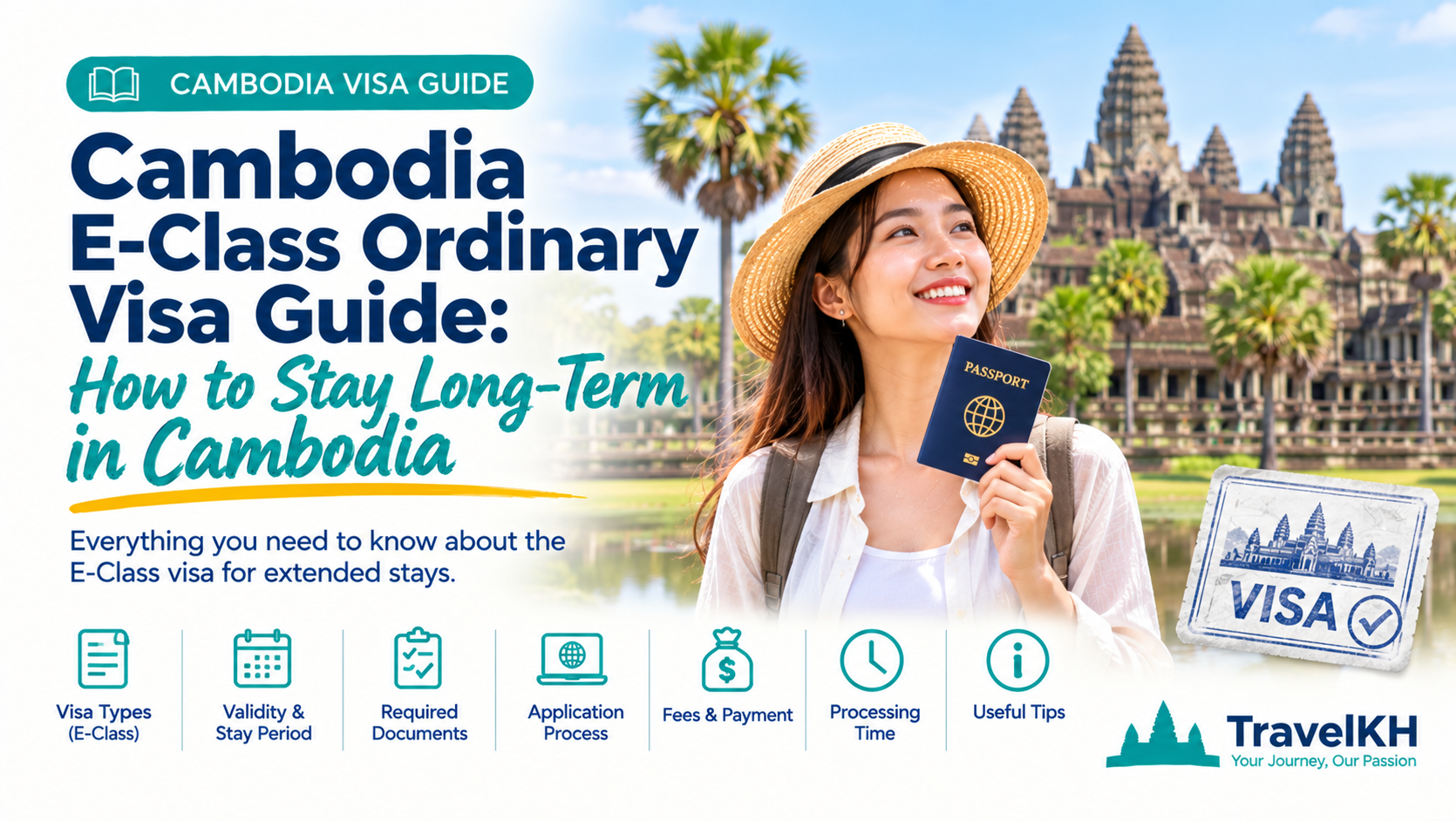
Are you planning to live, work, study, retire or start a business in Cambodia? If so, the E-Class Ordinary Visa, commonly called the E Visa, is one of the main visa options to understand before moving to the Kingdom.
Unlike the Tourist Visa (T Visa), which is intended for short visits, the Ordinary Visa is designed for foreigners who may need to remain in Cambodia for a longer period. It can be extended after arrival, depending on the purpose of stay and the supporting documents provided.
Cambodia is an increasingly popular destination for expats, digital nomads, business owners, retirees and international students. Understanding the E-Class Visa and its extension categories can help you plan your stay and avoid immigration problems.
This guide explains the Ordinary Visa, its application process, extension categories, requirements and important considerations for foreigners planning a longer stay in Cambodia.
1. What Is the Cambodia E-Class Ordinary Visa?
The E-Class Ordinary Visa is a Cambodian entry visa that allows eligible foreign visitors to enter Cambodia for an initial stay of up to 30 days.
It is commonly used by people who intend to:
- Work for a Cambodian company
- Start or operate a business
- Explore employment opportunities
- Retire in Cambodia
- Study at a Cambodian educational institution
- Stay with family or a partner
- Establish a longer-term life in Cambodia
The initial E-Class Visa is generally issued as a single-entry visa with a 30-day stay. After entering Cambodia, eligible holders can apply for an Extension of Stay (EOS) under the appropriate category.
Important: An E-Class Visa is not automatically a work permit, residence permit or permission to undertake any type of employment. Additional authorization may be required depending on your activities.
2. Cambodia E-Class Visa at a Glance
| Item | Details |
|---|---|
| Visa name | E-Class Ordinary Visa |
| Common name | E Visa |
| Visa purpose | Ordinary entry for non-tourist purposes |
| Initial stay | 30 days |
| Entry type | Single entry |
| Visa validity | 3 months from issue date |
| Official e-Visa fee | US$35 |
| Official e-Visa processing time | Approximately 3 business days |
| Extension available | Yes, subject to eligibility |
| Extension categories | EB, ER, ES and EG |
| Application | Official e-Visa website or other authorized visa channels |
| Work authorization | Separate work permit may be required |
The above initial visa details are based on the official Cambodian e-Visa information. Extension approval, duration, fees and supporting documents depend on the applicant's circumstances and current immigration requirements.
3. Difference Between E-Class Visa and E-Visa Online
This is one of the most confusing things about Cambodia's immigration system.
The terms E-Class Visa and e-Visa sound similar, but they refer to different things.
- E-Class Ordinary Visa: The visa category for people entering Cambodia for purposes other than ordinary tourism.
- e-Visa: An electronic application and visa issuance service provided through the Cambodian government's official website.
The Cambodian government now allows applicants from all countries to apply online for the electronic Type E visa, following its announcement on 31 August 2026.
In other words, the E-Class Visa can be obtained through an electronic application channel. The fact that it is an e-Visa does not mean it is a separate long-term residence visa.
The initial online E visa still provides a 30-day stay. Applicants who want to remain longer must arrange the appropriate Extension of Stay after entering Cambodia.
Official application website: https://www.evisa.gov.kh/
4. E-Class Visa Extension Categories
After entering Cambodia with an eligible Ordinary Visa, foreigners may apply for an Extension of Stay according to their purpose of residence.
The main categories commonly used by long-term residents are EB, ER, ES and EG.
A. EB Extension – Business and Employment
The EB Extension is commonly used by foreigners who work, operate businesses or conduct professional activities in Cambodia.
It may be suitable for:
- Employees working for Cambodian companies
- Business owners and entrepreneurs
- Self-employed professionals
- Freelancers
- Eligible family members of EB holders
Common supporting documents may include:
- Valid passport and current visa
- Employment contract or employment confirmation
- Company registration documents
- Patent tax certificate
- Work permit and foreign employment card, where applicable
- Other documents supporting the purpose of stay
A foreigner who works in Cambodia should also check the requirements for a Cambodian work permit and foreign employment card through the Ministry of Labour and Vocational Training.
Important: Holding an EB Extension alone does not automatically authorize employment. Visa status and work authorization are separate matters.
B. ER Extension – Retirement
The ER Extension is intended for foreigners who are retiring and wish to stay in Cambodia without taking up employment.
It may be suitable for:
- Retired foreigners
- Pension recipients
- Individuals who have reached retirement age and can demonstrate sufficient financial support
Common supporting documents may include:
- Valid passport and current visa
- Evidence of retirement or pension income
- Financial documents demonstrating the ability to support oneself
- Other documents requested by immigration authorities
Applicants should confirm the current age, financial and documentary requirements before applying. Do not assume that simply reaching a particular age guarantees approval.
C. ES Extension – Student
The ES Extension is designed for foreigners studying in Cambodia.
It may be suitable for:
- University students
- Students enrolled in recognized educational institutions
- Foreigners undertaking eligible language or educational programmes
Common supporting documents may include:
- Valid passport and current visa
- Enrollment confirmation
- Student identification or school documents
- Confirmation of the study programme and its duration
- Other documents requested by immigration authorities
Students should confirm that their educational institution and programme are acceptable for the requested extension.
D. EG Extension – General or Job-Seeking
The EG Extension is commonly associated with foreigners who are exploring employment opportunities or arranging their next steps in Cambodia.
It may be suitable for:
- Foreigners looking for employment
- People who have recently arrived and are exploring opportunities
- Individuals who need additional time to determine their longer-term immigration category
Depending on the circumstances, an EG Extension may be granted for a limited period.
Important: EG is not a guaranteed long-term residence option. Approval and renewal depend on immigration assessment. Foreigners who find employment or establish another qualifying purpose should investigate changing to the appropriate extension category.
5. Comparison of Cambodia's E-Class Extensions
| Extension | Main purpose | Typical applicant |
|---|---|---|
| EB | Business and employment | Employees, entrepreneurs and eligible dependants |
| ER | Retirement | Retired foreigners |
| ES | Education | International students |
| EG | General or job-seeking | Foreigners exploring employment or their next status |
The exact eligibility conditions, supporting documents and permitted extension periods must be confirmed with Cambodian immigration authorities or an authorized visa service provider.
6. How Long Can You Stay in Cambodia With an E-Class Visa?
The initial E-Class Visa provides a stay of up to 30 days.
Eligible applicants may subsequently apply for an extension of one, three, six or twelve months, depending on the extension category and approval.
Some EB, ER and ES extensions may be issued with multiple-entry privileges, particularly for longer extension periods. Shorter extensions may have different entry conditions.
A multiple-entry extension can be useful for foreigners who travel regularly between Cambodia and other countries.
However, always check the entry conditions printed on your approved extension before leaving Cambodia.
Example:
A foreigner planning to work in Phnom Penh may:
- Apply for an E-Class Visa.
- Enter Cambodia and receive an initial 30-day stay.
- Secure the required employment and company documents.
- Apply for an eligible EB Extension.
- Arrange the required work authorization separately.
The extension is not automatic. The applicant must meet the relevant requirements and obtain approval.
7. How to Apply for a Cambodia E-Class Visa
Foreigners can apply for an E-Class Visa through the Cambodian government's official electronic visa platform or other authorized visa application channels.
Option 1: Apply Online
The official Cambodian e-Visa website provides an electronic application service.
Application steps:
- Visit https://www.evisa.gov.kh/
- Select Visa E.
- Complete the online application form.
- Provide the required passport and personal information.
- Upload the required photograph and supporting documents.
- Pay the applicable visa fee.
- Wait for the application result.
- Download and check the approved visa certificate.
According to the official website, the published processing time is approximately three business days.
Applicants should apply sufficiently in advance and check that their passport details are correct.
Option 2: Apply Through a Cambodian Embassy or Authorized Visa Channel
Foreigners may also check with a Cambodian embassy or authorized visa service about obtaining an Ordinary Visa before travelling.
Availability, supporting documents, processing times and fees can vary depending on the application channel.
Option 3: Visa on Arrival
Eligible foreign travellers may be able to obtain an Ordinary Visa upon arrival at designated Cambodian immigration checkpoints.
Before travelling, confirm that the intended checkpoint issues the required visa category and that your nationality is eligible for that application method.
Do not assume every border checkpoint provides the same visa services.
8. Documents Required for an E-Class Visa
For an online E-Class Visa application, the official e-Visa website lists the following basic requirements:
- Passport with more than six months of validity remaining at the time of entry
- Recent passport-size photograph in digital format
- Valid payment method
For a longer-term extension, additional supporting documents may be necessary.
The documents depend on the requested category:
| Extension | Examples of supporting documents |
|---|---|
| EB | Employment letter, company documents, patent tax certificate and work authorization where applicable |
| ER | Retirement evidence, pension or financial documents |
| ES | School enrollment confirmation and study documents |
| EG | Passport, current visa and supporting information explaining the purpose of the application |
These are examples rather than a complete official checklist. Immigration authorities may request additional evidence.
9. Does an E-Class Visa Allow You to Work in Cambodia?
No. An E-Class Visa by itself does not automatically grant permission to work.
Foreigners intending to work in Cambodia should distinguish between:
1. Immigration status
The appropriate visa and Extension of Stay allow a foreigner to remain in Cambodia for an approved period and purpose.
2. Work authorization
A foreigner undertaking employment or other activities covered by Cambodian work-permit regulations must comply with the applicable work permit and foreign employment card requirements.
Employers and employees should check the current rules with the Ministry of Labour and Vocational Training.
Official work permit platform: https://www.fwcms.mlvt.gov.kh/
10. Can You Bring Your Spouse and Children to Cambodia?
Foreigners who hold an EB Extension may be able to arrange eligible extensions for their spouse and children, subject to immigration requirements and supporting documents.
Documents that may be requested include:
- Passport copies
- Marriage certificate
- Children's birth certificates
- Copies of the principal applicant's visa or extension
- Employment or company documents
- Other evidence of the family relationship
A boyfriend, girlfriend or fiancé does not automatically qualify as a legal spouse for immigration purposes.
Couples who are not legally married should confirm the applicable visa category and requirements rather than assuming that engagement provides family-based immigration eligibility.
11. Foreigners Living in Cambodia: FPCS Registration
Foreigners staying in Cambodia should also pay attention to the Foreigners Present in Cambodia System (FPCS).
FPCS is used to register foreigners at their place of accommodation.
Depending on the accommodation arrangement, registration is generally handled by:
- Hotel or guesthouse management
- Landlords
- Property managers
- Hosts or relevant accommodation providers
Foreigners staying in rented apartments or private homes should confirm that their registration has been completed correctly.
FPCS registration can be important when applying for visa extensions. Failure to register or incorrect address information may create problems during immigration procedures.
12. Can You Leave Cambodia and Return With an E-Class Extension?
This depends on the entry conditions of your approved extension.
Some longer extensions offer multiple-entry privileges, while other extensions may be single-entry.
Before leaving Cambodia, check:
- Whether your extension is single or multiple entry
- Its expiry date
- Whether a re-entry arrangement is required
- Whether your passport remains valid
Do not assume that an extension automatically permits unlimited travel in and out of Cambodia.
13. What Happens If You Overstay Your Cambodia Visa?
Overstaying means remaining in Cambodia beyond the permitted date of stay without an approved extension or other valid immigration status.
Consequences may include:
- Overstay fines
- Immigration questioning
- Detention or deportation in serious circumstances
- Difficulties with future entry or visa applications
Cambodian immigration authorities enforce overstay rules. Foreigners should not wait until their visa expires before arranging an extension.
If your visa is approaching its expiry date, contact immigration authorities or an authorized visa service provider as early as possible.
14. E-Class Visa vs. Tourist Visa: Which One Should You Choose?
Choosing the right visa depends on your reason for visiting Cambodia.
| Comparison | Tourist Visa (T) | Ordinary Visa (E) |
|---|---|---|
| Main purpose | Tourism and short visits | Non-tourist purposes and potential longer stays |
| Initial stay | 30 days | 30 days |
| Official online fee | US$30 | US$35 |
| Initial entry | Single entry | Single entry |
| Extension | Generally one 30-day tourist extension | Eligible extensions under EB, ER, ES or EG |
| Long-term employment pathway | Not the usual route | EB may be appropriate |
| Retirement pathway | Not the usual route | ER may be appropriate |
| Study pathway | Not the usual route | ES may be appropriate |
Which should you choose?
- Tourists: Consider the T-Class Tourist Visa.
- Employees and business owners: Consider the E-Class Visa and an eligible EB Extension.
- Retirees: Consider the E-Class Visa and ER Extension.
- Students: Consider the E-Class Visa and ES Extension.
- Job seekers: Consider the E-Class Visa and investigate EG eligibility.
If you already know that you intend to stay in Cambodia for a longer period, it is sensible to investigate the Ordinary Visa before travelling.
15. Frequently Asked Questions
Q1: Is the E-Class Visa the same as a Business Visa?
Not exactly. The E-Class Ordinary Visa is the entry visa category. EB is one of the extension categories commonly associated with business and employment.
Q2: Can I apply for an E-Class Visa online?
Yes. Since 31 August 2026, the official Cambodian e-Visa platform has announced that the electronic Type E visa is available for applicants from all countries.
Q3: How much does the Cambodia E-Class e-Visa cost?
The official online E-Class Visa fee is US$35. This is the initial visa fee, not the cost of a subsequent extension.
Q4: Can I extend my E-Class Visa for one year?
Eligible applicants may apply for a twelve-month Extension of Stay. Approval depends on the extension category and supporting documents.
Q5: Can I work in Cambodia with an E-Class Visa?
The visa alone does not authorize employment. Foreigners who work in Cambodia must comply with the relevant work-permit and foreign employment card requirements.
Q6: Can I change from a Tourist Visa to an EB Extension?
Do not assume that a Tourist Visa can be converted directly into an EB Extension. Confirm the available procedure with immigration authorities before relying on a change of category.
Q7: Can I renew my E-Class Visa indefinitely?
Some extension categories may be renewed repeatedly if the applicant continues to meet the relevant requirements. This is not an unconditional right, and approval is subject to immigration assessment.
Q8: Does an E-Class Visa allow multiple entries?
The initial E-Class Visa is single-entry. Multiple-entry privileges may be available with certain approved extensions. Always check the actual document.
Q9: Can my fiancé or fiancée receive the same extension as my spouse?
Engagement alone does not establish legal spousal status. Immigration authorities may require an official marriage certificate for a spouse-based application.
Q10: Do I need to register my address in Cambodia?
Foreigners should ensure their accommodation details are properly registered through FPCS. This can be important when applying for an extension.
16. Useful Official Websites and Resources
Before applying for a visa or extension, check the latest requirements through these official channels:
| Authority / Service | Official website |
|---|---|
| Cambodian e-Visa | https://www.evisa.gov.kh/ |
| General Department of Immigration | https://immigration.gov.kh/ |
| Cambodia e-Arrival | https://arrival.gov.kh/ |
| Ministry of Labour and Vocational Training | https://www.mlvt.gov.kh/ |
| Foreign Worker Centralized Management System | https://www.fwcms.mlvt.gov.kh/ |
Final Thoughts
The Cambodia E-Class Ordinary Visa is an important option for foreigners who intend to stay in Cambodia beyond a short holiday.
Whether you are planning to work in Phnom Penh, open a business in Siem Reap, retire near the coast, study Khmer or build a new life in Cambodia, understanding the different extension categories can help you choose the appropriate immigration pathway.
The most important thing is to remember that a visa, an Extension of Stay and a work permit are not the same document. Each has its own purpose and requirements.
Plan your immigration status before your current permission expires, keep your supporting documents organized and always verify the latest rules with the relevant Cambodian authorities.
TravelKH Disclaimer
This article is intended for general information and educational purposes only. Cambodian immigration policies, visa fees, eligibility criteria, supporting documents and application procedures may change without prior notice.
All visa and immigration information must be verified with the official Cambodian government websites or the relevant immigration authorities before applying, travelling or making any decision.
TravelKH.com does not provide immigration or legal services and cannot guarantee visa approval. Individual applications are assessed by the competent Cambodian authorities.