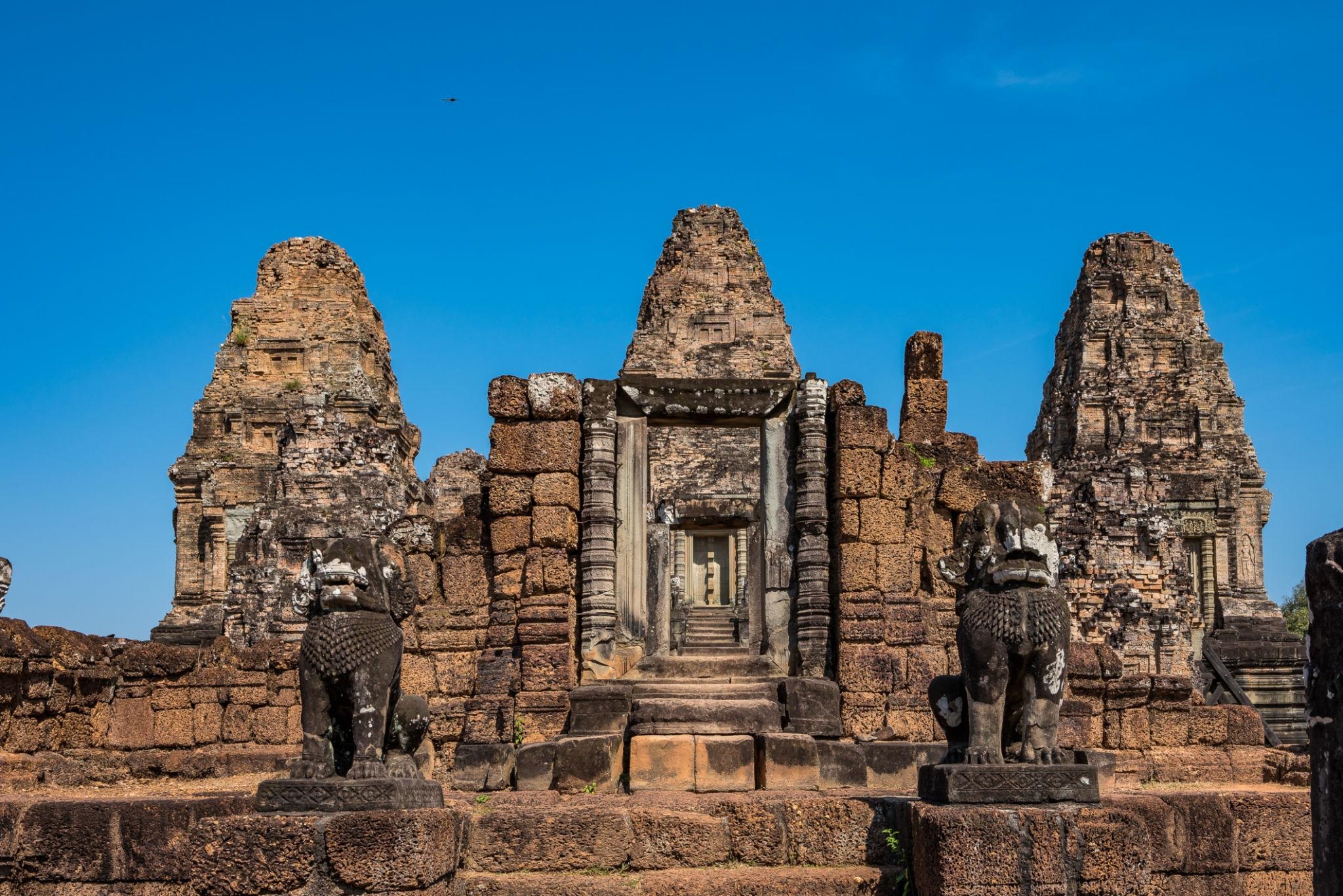

East Mebon Temple is one of the most distinctive ancient temples in Angkor Archaeological Park. Its five brick towers, impressive stone elephants, and elevated terraces tell the story of a time when this temple stood on an island in the middle of a vast artificial reservoir.
Today, the reservoir known as the East Baray is largely dry, leaving the temple surrounded by land rather than water. Visitors can walk around the terraces, admire the surviving sculptures, and imagine how people once travelled by boat to reach this sacred place.
Located near Preah Rup Temple, East Mebon is a rewarding stop for travellers interested in Khmer history, Hindu architecture, and the engineering achievements of the Angkorian civilisation.
History of East Mebon Temple
East Mebon was built during the reign of King Rajendravarman II in the 10th century. Its principal religious dedication took place in 953 AD, and the temple was associated with Hindu worship, particularly the god Shiva.
The temple was constructed on an artificial island in the East Baray, a huge reservoir developed during the reign of King Yasovarman I in the late 9th century. The reservoir helped regulate water and support the surrounding agricultural landscape.
When East Mebon was first built, visitors would have approached the island by boat. The laterite landing platforms and the temple's elevated design reflect its original relationship with the water.
As the reservoir gradually dried, the temple became accessible across the surrounding land. Its surviving brick sanctuaries and stone sculptures now provide important evidence of Angkor's architectural and religious history.
What Makes East Mebon Temple Special?
1. Five brick towers
The upper platform contains five principal towers arranged in a quincunx pattern: one central tower surrounded by four others. This arrangement is associated with the sacred mountain symbolism found in Khmer temple architecture.
The towers are built mainly of brick, with sandstone details around important architectural features. Their reddish colour creates a striking contrast with the greenery around the site.
2. Stone elephant sculptures
One of East Mebon's most memorable features is its stone elephants positioned at the corners of the temple's terraces. These sculptures remain an important part of the monument's identity.
Take time to examine their trunks, legs, and decorative details. They offer a good opportunity to appreciate the craftsmanship of Angkorian sculptors.
3. The ancient East Baray
The temple's original setting is central to its story. East Mebon once stood on an island in the East Baray, a reservoir that formed part of Angkor's wider water-management system.
Although the reservoir is no longer the vast body of water it once was, understanding this landscape helps explain why the temple was designed as an elevated island sanctuary.
4. Sandstone lintels and decorative details
Look for carved lintels, doorframes, guardian figures, and other surviving stone decorations. Some details are better preserved than others, so moving slowly around the temple can reveal features that are easy to miss.
5. A quieter alternative to Angkor's major temples
East Mebon is generally a shorter visit than Angkor Wat or Bayon. It is a useful choice for visitors who want to explore another part of Angkor's history without spending several hours at a single monument.
Where Is East Mebon Temple?
Location: Angkor Archaeological Park, Siem Reap Province, Cambodia.
East Mebon lies approximately 500 metres north of Preah Rup Temple. It is commonly included in a Grand Circuit itinerary or combined with nearby temples east of Angkor Thom.
How to get there
- Tuk-tuk: A convenient way to visit East Mebon and other temples in one day.
- Private car: A comfortable option for families and travellers who prefer air-conditioned transport.
- Bicycle: Suitable for active visitors who are prepared for the distance and Cambodia's heat.
- Guided tour: A good choice if you want to learn about the East Baray, Hindu symbolism, and the history of Angkor's water system.
Ask your driver to combine East Mebon with Preah Rup or other nearby temples to make the most of your visit.
Opening Hours and Entrance Fee
| Visitor information | Details |
|---|---|
| Typical opening hours | 7:00 AM–5:30 PM |
| Entrance fee | No separate temple fee |
| Angkor Pass | Generally required |
| Recommended visit | Around 30 minutes |
| Main highlights | Five brick towers, stone elephants, sandstone carvings |
The APSARA National Authority lists East Mebon's opening hours as 7:00 AM to 5:30 PM and recommends approximately 30 minutes for a visit.
East Mebon is part of the Angkor Archaeological Park ticketing system, so a valid Angkor pass generally covers entry. Check the official Angkor Enterprise ticket page for current prices and conditions before your trip.
Best Time to Visit East Mebon
Early morning: Cooler temperatures make walking around the temple more comfortable. Morning light can also bring out the texture of the brick towers and stone carvings.
Late afternoon: The warmer light creates attractive colours on the brickwork. East Mebon can be combined with Preah Rup, although you should check each site's closing time.
Dry season: The surrounding landscape is often easier to explore, but the weather can be hot and dusty.
Rainy season: The landscape may be greener, and the temple's relationship with Angkor's historic water system becomes particularly interesting to imagine. Carry suitable footwear if paths are wet.
For most visitors, the best approach is to arrive early or visit between other stops on the Grand Circuit.
Things to See and Do at East Mebon
- Walk around the lower terraces: Notice the laterite construction and the layout of the temple.
- Look closely at the elephants: The sculptures at the corners are among the site's best-known features.
- Explore the five towers: Observe their arrangement and the surviving brickwork.
- Photograph the sandstone details: Doorframes and lintels provide interesting close-up subjects.
- Learn about the East Baray: Imagine the temple as an island sanctuary reached by boat.
- Compare East Mebon with Preah Rup: Both temples are associated with King Rajendravarman II's period and share architectural characteristics.
Please respect the site's conservation rules. Avoid climbing on fragile structures or touching delicate carvings.
Nearby Attractions
| Attraction | Why visit? | Suggested time |
|---|---|---|
| Preah Rup Temple | A dramatic brick temple-mountain with stepped terraces | 30–45 minutes |
| Banteay Samre | Detailed carvings and a well-proportioned temple complex | 45–60 minutes |
| Srah Srang | An ancient reservoir with a sandstone landing terrace | 15–30 minutes |
| Banteay Kdei | Galleries, courtyards, and atmospheric ruins | 40–60 minutes |
| Ta Prohm | Famous for trees growing among temple ruins | 45–90 minutes |
| Ta Som | A smaller temple known for its tree-framed gate | 30–45 minutes |
Visit times are estimates and will depend on your interests and the route you choose.
Suggested Grand Circuit Itinerary
| Order | Stop | What to explore |
|---|---|---|
| 1 | Preah Khan | Large temple complex with galleries and courtyards |
| 2 | Neak Pean | Island sanctuary and surrounding water features, subject to access |
| 3 | Ta Som | Compact temple with distinctive tree-covered architecture |
| 4 | East Mebon | Brick towers and stone elephant sculptures |
| 5 | Preah Rup | Temple-mountain architecture and reddish brickwork |
This itinerary can be adapted to your departure time, weather, and preferred pace. If you want to spend more time photographing the temples, consider reducing the number of stops.
East Mebon vs West Mebon
The names are similar, but these are two different temples.
| Feature | East Mebon | West Mebon |
|---|---|---|
| Location | Former East Baray | Western Baray |
| Period | 10th century | Mid-11th century |
| Historical setting | Once stood on an island in the East Baray | Located at the centre of the Western Baray |
| Known for | Five brick towers and stone elephants | Island setting and a famous bronze Vishnu sculpture discovered in 1936 |
| Visit planning | Commonly combined with Preah Rup | Access may involve a boat trip, depending on conditions |
East Mebon is generally the easier option to include in a standard temple circuit. For West Mebon, check current access arrangements before making a special trip.
Practical Tips for Visitors
- Carry a valid Angkor pass.
- Wear comfortable shoes because the ground and steps are uneven.
- Bring drinking water and sun protection.
- Allow around 30 minutes for a straightforward visit.
- Look at the elephants from several angles to appreciate their details.
- Combine the temple with Preah Rup for a convenient half-day or full-day itinerary.
- Respect barriers and conservation measures around the ancient structures.
Frequently Asked Questions
Is East Mebon Temple worth visiting?
Yes. It is especially worthwhile for travellers interested in brick architecture, ancient Khmer sculpture, and Angkor's water-management history.
Why was East Mebon built in the middle of a reservoir?
The temple was designed as a sacred island sanctuary in the East Baray. Its original setting connected religious architecture with the wider landscape and water system of Angkor.
Who built East Mebon Temple?
East Mebon was built during the reign of King Rajendravarman II and was dedicated in 953 AD.
How long should I spend at East Mebon?
Around 30 minutes is a reasonable visit, although photography and a closer examination of the carvings may take longer.
Is East Mebon included in the Angkor Pass?
Yes. It is generally covered by a valid Angkor Archaeological Park pass. Confirm current ticket information through Angkor Enterprise before travelling.
What is the difference between East Mebon and Preah Rup?
Both are 10th-century Hindu temples associated with King Rajendravarman II. East Mebon is known for its island-reservoir history and stone elephants, while Preah Rup is recognised for its larger stepped temple-mountain structure and distinctive reddish brick towers.
TravelKH Tip
Visit East Mebon and Preah Rup on the same day. Compare the brick towers and stone details at both sites, then imagine how the landscape would have looked when the East Baray held water and East Mebon stood on an island. It is a useful way to understand Angkor as a connected landscape rather than a collection of separate temples.












Leave a Reply