
Prei Monti is one of the lesser-known archaeological sites in the Roluos area of Siem Reap. Unlike the grand pyramid of Bakong or the decorated brick towers of Preah Ko, this quiet and partially ruined monument offers a different experience: a glimpse into the early urban landscape of the Khmer Empire.
The site is particularly interesting because it may have formed part of the royal palace precinct of Hariharalaya, the early Khmer capital at Roluos. Its three brick towers, large surrounding enclosure and unusual carved stone basin make it a worthwhile stop for travellers interested in archaeology and lesser-visited heritage sites.
Prei Monti is not a polished tourist attraction. Access can be less straightforward, facilities are limited, and the remains are modest. Its value lies in its historical context and the opportunity to explore a quieter part of early Angkorian Cambodia.
Quick Facts About Prei Monti Temple
| Information | Details |
|---|---|
| Temple Name | Prei Monti Temple |
| Khmer Name | ប្រាសាទព្រៃមន្ទីរ |
| Alternative Name | Prasat Prei Monti |
| Historical Period | 9th century |
| Associated Ruler | King Indravarman I (according to APSARA's site information) |
| Original Religion | Hinduism |
| Main Architectural Features | Three brick towers on a shared sandstone base |
| Location | Thnâl Trang Village, Bakong Commune, Prasat Bakong District, Siem Reap Province |
| Distance from Siem Reap | Approximately 15 km |
| Distance from Bakong | Approximately 2 km south, according to APSARA |
| Opening Hours | 7:30 AM–5:30 PM (published APSARA information) |
| Recommended Visit | 20–30 minutes |
| Entrance Fee | Confirm current ticket requirements before visiting |
| Best Time to Visit | November–February |
1. History of Prei Monti Temple
Prei Monti is an early Khmer archaeological site in the Roluos area, associated with the ancient capital of Hariharalaya.
Hariharalaya was one of the earliest important centres of Khmer royal power before the political and religious centre moved towards the Angkor area.
The site dates to the 9th century and is associated with the reign of King Indravarman I, according to the APSARA National Authority's visitor information.
Some archaeological interpretations suggest that the wider Prei Monti enclosure may have served as part of the royal palace precinct of Hariharalaya. This possibility makes the site particularly important for understanding how the early Khmer capital was organised.
Unlike Bakong, which was a major state temple, Prei Monti appears to have been part of a broader complex of buildings and enclosed spaces.
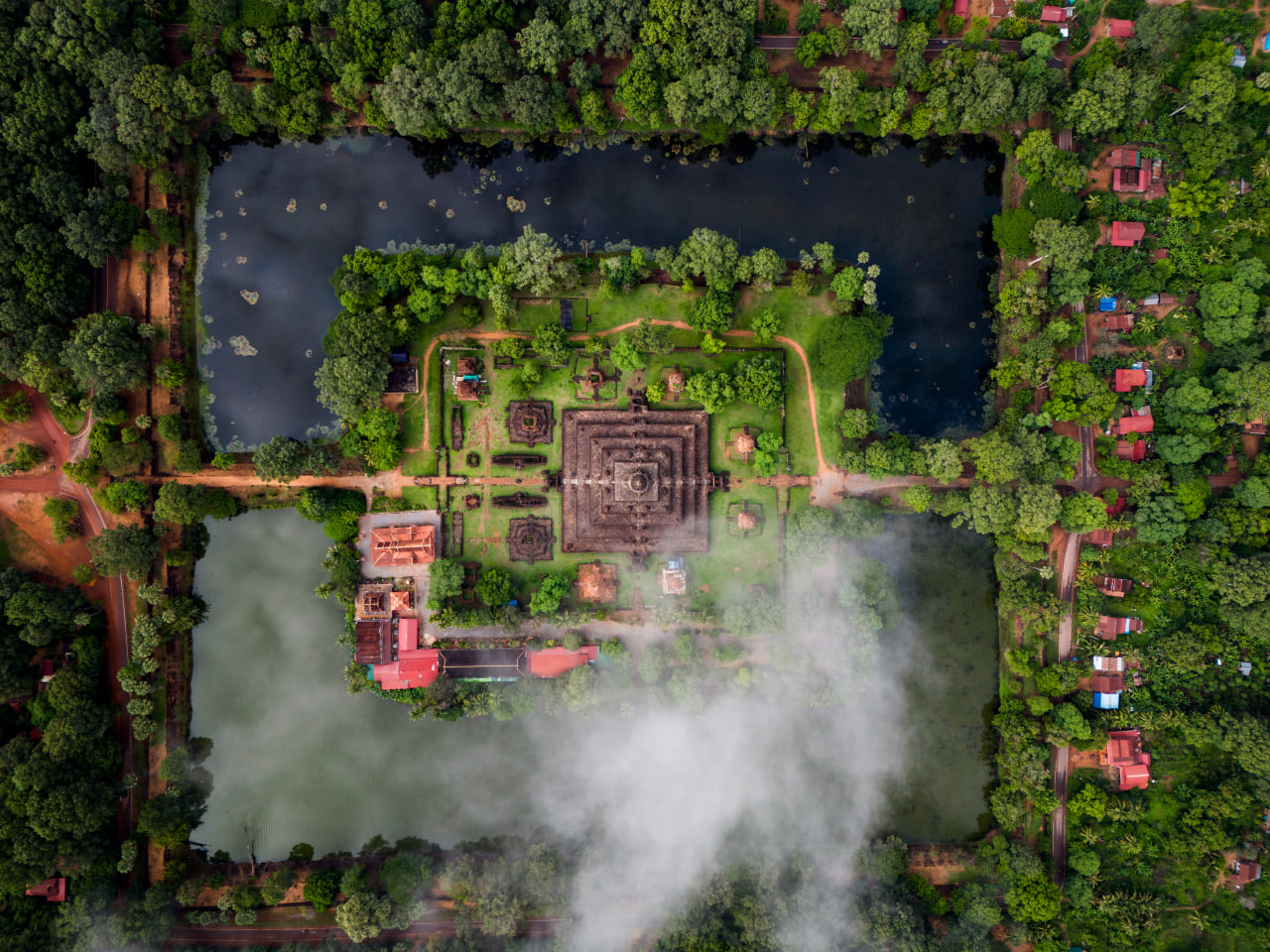
Archaeological records describe a large rectangular area, approximately 800 metres by 500 metres, defined by an outer moat. The wider enclosure contains evidence that may help researchers understand the relationship between royal residences, religious buildings and the ancient city's water-management system.
However, the exact function of every structure within the enclosure is not fully established.
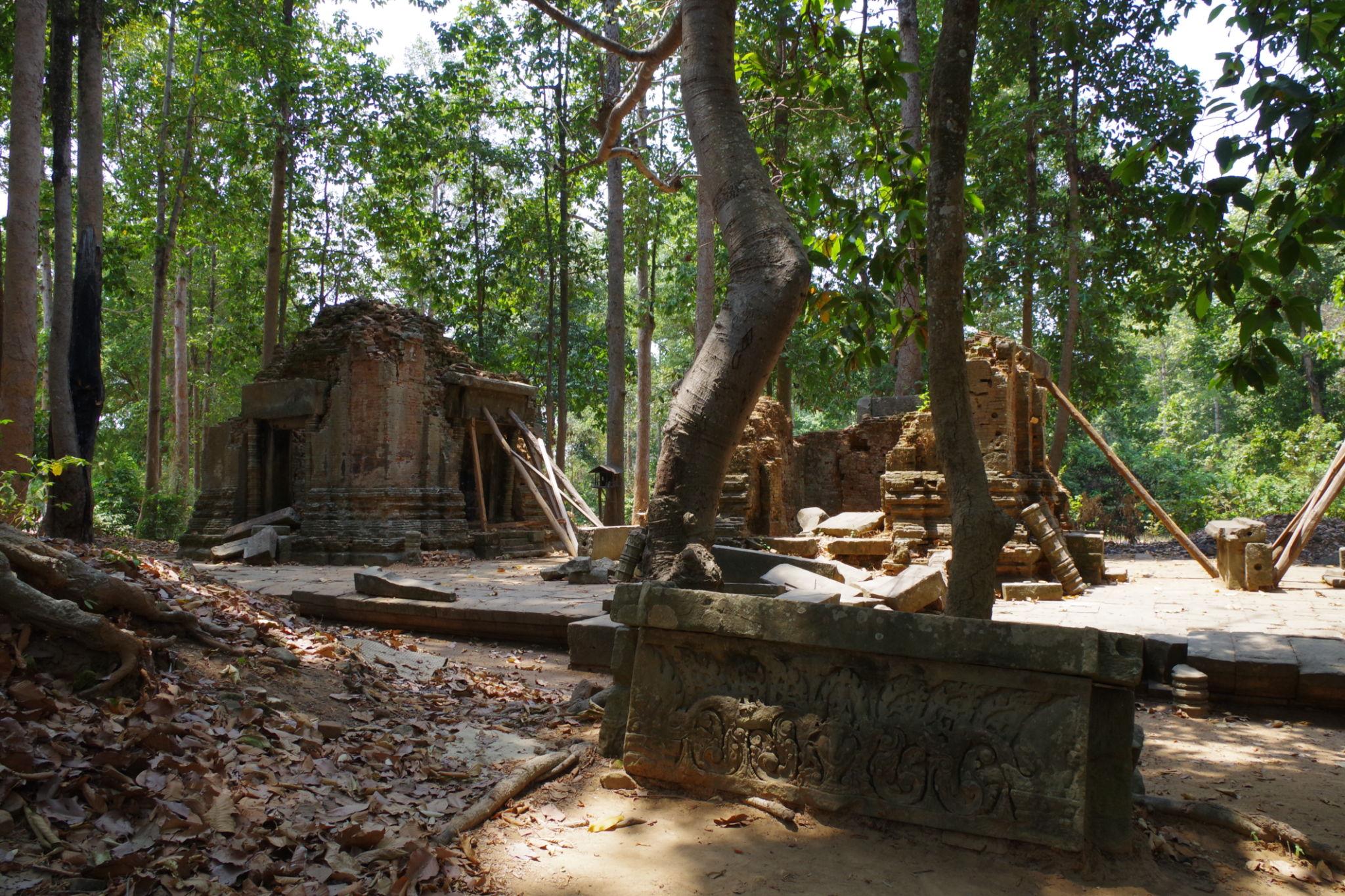
Today, visitors mainly see the remains of three brick towers and a distinctive carved stone basin. Although modest in appearance, these remains provide valuable evidence of early Khmer construction and religious traditions.
2. Why Is Prei Monti Temple Special?
A possible royal palace precinct
One of the most interesting aspects of Prei Monti is its possible connection with the royal palace of Hariharalaya.
While the three surviving towers are relatively small, the archaeological enclosure is much larger. Its layout suggests that the site may have served a broader purpose than a standalone temple.
This makes Prei Monti interesting for visitors who want to understand how the early Khmer capital functioned beyond its major religious monuments.
Three ancient brick towers
The visible sanctuary area consists of three brick towers built on a shared sandstone base.
The towers are partially ruined, with sections of their original structures missing or deteriorated.
Unlike the more complete monuments at Bakong and Preah Ko, Prei Monti provides a closer look at the effects of time on early Khmer architecture.
An unusual carved stone basin
One of the site's distinctive features is a large carved stone basin or trough near the entrance area.
Its original purpose is not definitively established. It is an interesting archaeological feature that deserves attention when exploring the ruins.
A quiet archaeological atmosphere
Prei Monti receives considerably less attention than the principal Roluos temples.
Its peaceful setting, surrounding trees and partially collapsed brick structures create a different atmosphere from the more frequently visited Angkor monuments.
For travellers who enjoy discovering lesser-known historical places, this is part of its appeal.
3. What to See at Prei Monti Temple
3.1 The three brick towers
The three brick towers are the main structures visitors come to see.
They stand on a shared sandstone base and represent the remains of an early Khmer sanctuary complex.
Some sections are heavily weathered or collapsed. Visitors should avoid climbing on the structures or touching unstable masonry.
Take time to observe the brickwork and surviving architectural details.
3.2 The carved stone basin
The stone basin near the entrance is one of the most unusual features of Prei Monti.
It is a large carved stone structure whose original function remains uncertain.
Some descriptions refer to it as a stone trough or basin. Its purpose should not be presented as definitively known without further archaeological evidence.
3.3 The sandstone foundation
The three brick sanctuaries stand on a shared sandstone base.
This combination of brick and sandstone was common in early Khmer religious architecture.
The foundation is an interesting detail for visitors studying the development of temple construction before the more monumental sandstone structures of later Angkor.
3.4 The surrounding archaeological enclosure
The wider Prei Monti site is much larger than the small temple ruins visible to visitors.
The reported outer enclosure measures approximately 800 by 500 metres and is associated with a surrounding moat.
The wider landscape is particularly important to archaeological interpretations of Hariharalaya's urban and royal layout.
Visitors should understand that the three towers represent only a small part of the broader historical site.
3.5 The surrounding trees and rural landscape
The temple is surrounded by a quieter rural environment, with trees and agricultural land in the wider area.
Compared with the main Roluos monuments, the atmosphere is more secluded.
This makes Prei Monti an interesting photography stop, particularly for visitors who enjoy documenting lesser-known historical ruins.
4. Location: How to Get to Prei Monti Temple
Prei Monti is located in Thnâl Trang Village, Bakong Commune, Prasat Bakong District, Siem Reap Province.
It is situated south of Bakong Temple in the wider Roluos archaeological area.
The site is not as straightforward to locate as Bakong, Preah Ko or Lolei. Visitors may need to use a map pin or ask a local driver for directions.
| Transport | Practical Information |
|---|---|
| Tuk-tuk | Possible with a driver familiar with the rural access route |
| Private car | Suitable for the main journey; final access should be checked locally |
| Motorbike | Convenient for experienced riders familiar with rural roads |
| Bicycle | Possible for adventurous visitors, but allow extra time |
| Local guide | Recommended for navigation and historical interpretation |
Important: Do not assume that every driver knows Prei Monti. Confirm the exact destination before leaving Siem Reap.
5. Road Conditions and Accessibility
Reaching Prei Monti is more challenging than visiting the three principal Roluos temples.
The main journey from Siem Reap is generally straightforward, but the final approach may involve narrow village roads, sandy tracks or unpaved sections.
| Travel Detail | Practical Information |
|---|---|
| Main route | Siem Reap towards Roluos and Bakong |
| Main road surface | Generally paved |
| Final approach | Smaller rural tracks; exact condition may vary |
| Suitable vehicles | Motorbike, bicycle and suitable private vehicles, depending on conditions |
| Tuk-tuk access | Confirm with the driver before departure |
| Rainy-season risks | Mud, slippery tracks, standing water and possible access difficulties |
| Walking required | May involve a short walk from the accessible road |
| Accessibility | Uneven ground, vegetation and archaeological rubble; not wheelchair accessible |
Dry-season access
During the dry season, some unpaved sections may be sandy or dusty.
A motorbike or bicycle can be convenient for visitors familiar with rural Cambodian roads. A private vehicle may be suitable if the driver confirms that the final approach is accessible.
Rainy-season access
During the rainy season, unpaved tracks may become muddy or slippery. Waterlogged areas and overgrown vegetation can make the final approach more difficult.
A local driver or guide who knows the current route is strongly recommended.
Walking and safety
The temple remains are uneven and partially collapsed. Wear closed-toe shoes and avoid climbing on the brick towers or unstable stonework.
Bring water and be prepared for limited visitor facilities.
TravelKH recommendation: Contact a local guide or driver familiar with Prei Monti before travelling. Verify the final access route on the day of your visit rather than relying entirely on an online map.
6. Opening Hours
APSARA National Authority publishes the following visitor hours for Prei Monti:
| Day | Opening Time | Closing Time |
|---|---|---|
| Monday–Sunday | 7:30 AM | 5:30 PM |
Because Prei Monti is a lesser-visited archaeological site, visitor facilities and on-site services may be limited.
Check local access arrangements before making a special trip.
7. Entrance Fee: Do You Need an Angkor Pass?
Prei Monti is part of the wider Angkor archaeological landscape and the Roluos area.
However, ticketing information for this smaller site is not as clearly documented as for the main Roluos temples.
| Question | Recommendation |
|---|---|
| Is it part of the Roluos archaeological area? | Yes |
| Is there a dedicated ticket booth? | Do not assume one is available |
| Is Angkor Pass coverage confirmed for this individual site? | Verify with Angkor Enterprise or APSARA |
| Should visitors carry a valid Angkor Pass? | Yes, particularly when combining the visit with the main Roluos monuments |
For the other principal Roluos temples, visitors should arrange the appropriate Angkor Pass before travelling.
Official ticket information:
Do not assume that the absence of a visible ticket checkpoint means that all access requirements are waived.
8. Best Time to Visit Prei Monti Temple
The most comfortable time to explore Prei Monti is generally during the cooler months from November to February.
| Season | Months | Visitor Experience |
|---|---|---|
| Cool season | November–February | More comfortable conditions for walking and exploring |
| Hot season | March–May | Hotter and drier; morning visits recommended |
| Rainy season | June–October | Lush surroundings but potentially muddy access tracks |
Recommended time: Visit between 8:00 AM and 10:00 AM when temperatures are generally more comfortable.
The dry season may make rural access easier, although the surrounding landscape can be less green.
9. How Long Should You Spend at Prei Monti?
The visible ruins are relatively small. APSARA recommends approximately 20 minutes for the visit.
| Activity | Estimated Time |
|---|---|
| Explore the three brick towers | 10 minutes |
| Examine the carved stone basin | 5 minutes |
| Walk around the visible ruins | 5–10 minutes |
| Photography | 5–10 minutes |
Allow approximately 20–30 minutes at the site, excluding the time required to find and reach it.
Visitors interested in archaeology and the wider enclosure may wish to spend longer exploring the surrounding area with a knowledgeable local guide.
10. Nearby Attractions: Explore the Roluos Area
Prei Monti is best included as an additional stop when exploring the Roluos Group.
| Attraction | Main Highlight | Suggested Visit |
|---|---|---|
| Bakong Temple | Five-tiered pyramid and early Khmer temple-mountain architecture | 45–90 minutes |
| Preah Ko Temple | Six brick towers and sacred Nandi bull sculptures | 30–45 minutes |
| Lolei Temple | Four brick towers and ancient inscriptions | 20–45 minutes |
| Prei Monti | Three brick towers and possible royal palace precinct | 20–30 minutes |
Bakong Temple
Bakong is the largest and most impressive monument in the Roluos Group.
Built under King Indravarman I, it represents an important development in the Khmer temple-mountain tradition.
Preah Ko Temple
Preah Ko was consecrated in 880 AD and is known for its six brick towers, sandstone details and sacred bull sculptures.
It provides an excellent comparison with the smaller brick structures at Prei Monti.
Lolei Temple
Lolei was consecrated in 893 AD under King Yasovarman I.
Its four brick towers were originally constructed on an artificial island in Indratataka Baray, a major ancient reservoir.
11. Suggested Half-Day Roluos and Prei Monti Itinerary
For visitors interested in early Khmer history, this itinerary includes the three principal Roluos temples and the lesser-known Prei Monti site.
| Time | Activity |
|---|---|
| 8:00 AM | Depart from Siem Reap |
| 8:30 AM | Visit Preah Ko Temple |
| 9:15 AM | Explore Bakong Temple |
| 10:15 AM | Travel towards Prei Monti |
| 10:30 AM | Explore Prei Monti ruins |
| 11:00 AM | Visit Lolei Temple |
| 11:45 AM | Optional local village stop |
| 12:15 PM | Return to Siem Reap |
Allow extra time for navigation and the final rural-road approach to Prei Monti.
The order can be adjusted according to road conditions and the driver's familiarity with the site.
12. Practical Tips for Visiting Prei Monti
- Use a local guide. Prei Monti is less clearly signposted than the main Roluos temples.
- Download an offline map. Mobile coverage and navigation may vary in rural areas.
- Wear closed-toe shoes. The ground may contain rubble, uneven surfaces and vegetation.
- Check road conditions. Rain can make the final approach difficult.
- Bring drinking water. Do not expect the same facilities available at major tourist attractions.
- Avoid climbing the ruins. The brick towers are fragile and partially collapsed.
- Respect the archaeological site. Do not remove bricks, stones or other historical objects.
- Carry cash. Do not assume that local services accept card payments.
- Combine with the Roluos Group. Visiting Prei Monti as part of a wider temple trip makes better use of your travel time.
13. Frequently Asked Questions
Where is Prei Monti Temple located?
Prei Monti is located in Thnâl Trang Village, Bakong Commune, Prasat Bakong District, Siem Reap Province, in the Roluos archaeological area.
How far is Prei Monti from Bakong Temple?
APSARA describes Prei Monti as approximately 2 kilometres south of Bakong Temple.
Who built Prei Monti Temple?
APSARA associates the site with the reign of King Indravarman I in the 9th century. The exact construction history and function of the wider complex remain subjects of archaeological interpretation.
How many towers does Prei Monti have?
The visible sanctuary consists of three brick towers built on a shared sandstone base.
Was Prei Monti the royal palace of Hariharalaya?
The wider archaeological enclosure has been interpreted as a possible royal palace precinct of Hariharalaya. However, this should be treated as an archaeological interpretation rather than an established fact about every structure at the site.
What is special about the stone basin?
A large carved stone basin or trough is one of the distinctive features of the site. Its exact original function is not definitively established.
Is Prei Monti worth visiting?
It is worth visiting for travellers interested in early Khmer archaeology, lesser-known temples and the history of Hariharalaya. Visitors expecting a large, well-preserved monument may find the site less impressive than Bakong or Preah Ko.
Can I visit Prei Monti by tuk-tuk?
Possibly, depending on the final road conditions and the driver's familiarity with the route. Confirm access before departure and be prepared to walk a short distance if necessary.
How long should I spend at Prei Monti?
Approximately 20–30 minutes is sufficient for the visible ruins. Allow additional time for travel and navigation.
TravelKH Tip
Prei Monti is not a major monument like Bakong, but it offers something different: a connection to the early royal landscape of Hariharalaya.
If you have already visited Bakong, Preah Ko and Lolei, consider adding Prei Monti to your itinerary. Its three brick towers and unusual stone basin may look modest, but the wider archaeological enclosure makes it an interesting place for understanding the early Khmer capital.
This destination is best suited to travellers who enjoy history, archaeology and discovering places away from the usual tourist routes.